
By clicking “Accept,” you agree to the storage of cookies on your device to improve website navigation, analyze site usage, and support our marketing efforts. For more information, please see our Privacy Policy.

All Insights
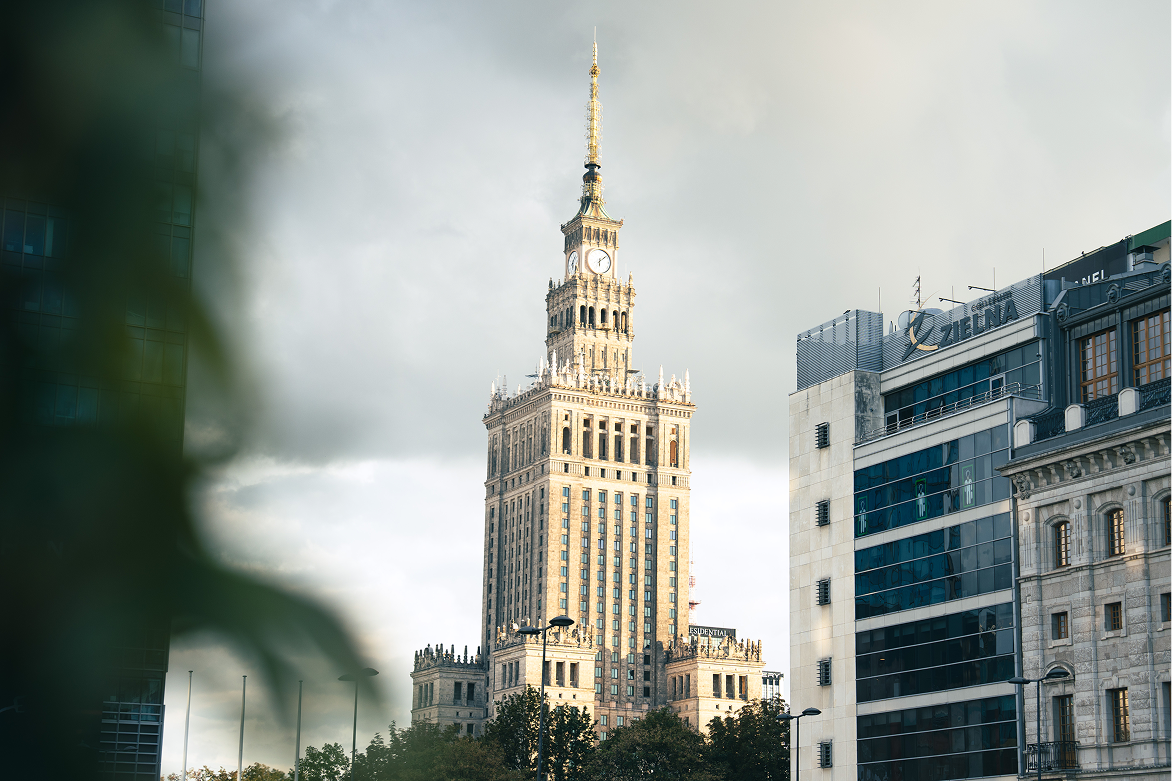
As an EU and NATO member on Europe’s eastern flank, Poland combines industrial strength with a drive for innovation, particularly in nearshoring, digitalisation, resilient supply chains, and defence technology. Last year, the country once again elected a populist president, which lends additional weight to questions of the rule of law, investment security, and European integration. From 9 to 11 September 2026, Friends members travelled to Warsaw to see first-hand how the country is driving its economic, technological, and security-policy realignment.
The first day began with first-hand assessments. Olaf Kjelsen, Swiss Ambassador to Poland, analysed the situation from a Swiss perspective. Agnieszka Homańska, Chief of Staff to Polish Foreign Minister Radosław Sikorski, added the Polish perspective in a very open and engaging exchange with our Friends. One principle ran through the conversation: separating signals from noise – taking Russia seriously without treating it as all-powerful. What we took away: deep insights into a country that has set itself clear goals since the end of the Cold War (NATO membership, EU membership, admission to the G20, fighting corruption) and pursued them with perseverance. Poland’s foreign policy deliberately stays this course today, with the aim of having a real say in European affairs.
Over lunch, Prof. Rafał Riedel, Professor of Political Science at the University of Opole, gave the Friends an unvarnished insight into Poland’s political and social reality. The country is caught between democratic renewal and populist headwinds – a pattern found across much of Europe. Riedel also pointed to the ‘Winkelried syndrome’ (‘Winkelriedyzm’), a concept that may sound curious to Swiss ears: Poland’s urge to throw itself, self-sacrificially and almost pre-emptively, in the path of an eastern threat on behalf of its European neighbours.
So how does economic strength emerge from this starting point?
This question was discussed by Paweł Panczyj, Managing Director, ABSL Poland; Mariusz Mulas, Roche Polska and Dr. Małgorzata Bonikowska, President of the Centre for International Relations. Since 1989, the Polish economy has undergone several fundamental transformations, most visibly in business services, a sector that has moved from simple cost-cutting to expertise and innovation. The coming wave of AI is therefore seen less as a threat than as an opportunity. Poland is increasingly positioning itself as Europe’s nearshoring hub, with a strong industrial base, a well-educated workforce, and stable supply chains. For Swiss companies looking to make their value chains more robust, this is a market of growing importance.
Awareness of the threat posed by Russia was palpable throughout the journey, in conversations about politics and business alike. On the second day, security therefore took centre stage. Experts from the Casimir Pulaski Foundation – among them Tomasz Smura, Sławomir Florek, Maciej Dachowski, and Maciej Bukowski – and war correspondent Tim Mak shed light on the military and technological realities on Europe’s eastern flank. For them, security and prosperity belong together: defence, competitiveness, energy security, and industrial capacity are closely intertwined.
Tim Mak described how Ukraine is accelerating innovation under pressure: it has flattened hierarchies, decentralised parts of its procurement, and brought developers closer to frontline units. At the same time, the Pulaski Foundation experts warned against concluding that drones will replace conventional armed forces. Modern deterrence requires both.
Resilience comes at a price, but it is worth investing in. The Friends then discussed what this means for European and Swiss companies – from risk assessment and location decisions to strategic partnerships – and what they can learn from Ukraine’s culture of innovation.
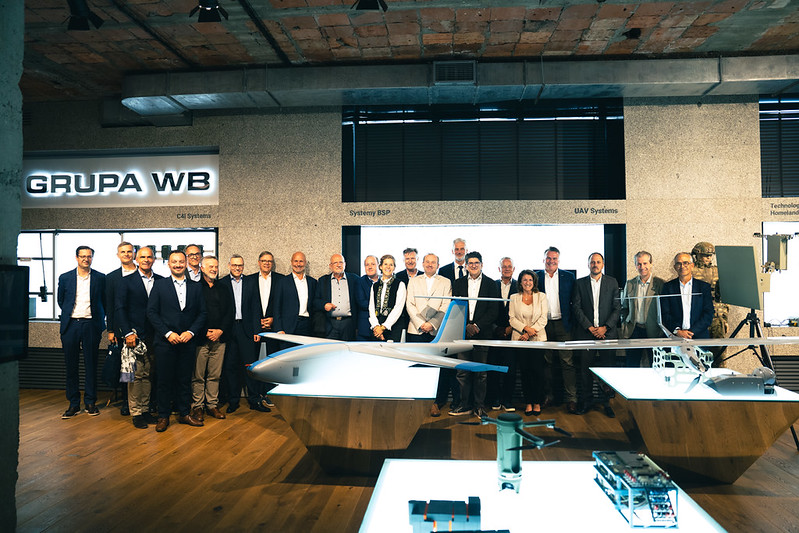
The highlight of the afternoon was the visit to the WB Group, Poland’s largest private defence company. Adam Bruliński, Advisor to the Board of WB Electronics, presented a company that develops unmanned aerial systems, military electronics, and command and reconnaissance systems. What had remained abstract on slides and in discussions that morning took on tangible form through the models in the showroom. Particularly revealing was the short path from development to deployment: systems are used under real conditions, generate data, and are continuously improved. Poland’s security industry has long since become an independent, innovation-driven sector in its own right.
At the end of the journey, one insight stands out. Poland is not a blueprint that can simply be copied, but it is a proof of concept: proof that a European country can fundamentally change course within a single generation. Poland’s rise is no accident. It is the result of a national effort shared by politics, business, and society despite difficult external conditions.
If Europe can learn anything from Poland, it is this: change is not a state of emergency but the norm. Nothing goes exactly to plan, and disruption is part of the process. Resilience means learning and adapting faster than circumstances change, through decentralisation, iteration, improvisation, and continuous improvement. In the discussion on the economy, this was described as ‘resilient transformation’. Poland sees itself less as a nation of great inventors than as a nation of improvers: it questions the status quo, identifies inefficiencies, and optimises continuously. The country also sets itself tangible benchmarks – Japan in the 1990s and, increasingly, South Korea today, as Bonikowska explained.
What stands out is the combination of acute threat awareness and unbroken confidence in the country’s own future – a contrast to parts of Western Europe, where pessimism and a lack of preparation often go hand in hand. At the same time, the model has its limits: the money spent on defence is not available for other priorities, and government and business still work together too little. Learning works both ways: Poland can benefit from Western Europe’s established forms of cooperation, and Western Europe from Poland’s sense of urgency and ambition.
This points beyond Poland: the capacity to act comes from ambition and imagination, not merely from defending the status quo. Poland shows that a positive vision of the future can itself become a strategic advantage: for a strong Europe that builds meaningful connections rather than closing itself off.
Next year, the Friends trip will take you to the Netherlands. From 15 to 17 September 2027, experience how one of Europe’s most open economies combines trade, innovation, and sustainability.
Become a Friends member and register now:
Head of Communication, Lucerne Dialogue


You will find more information about our upcoming activities in our newsletter.

Register here for our newsletter!
