
By clicking “Accept,” you agree to the storage of cookies on your device to improve website navigation, analyze site usage, and support our marketing efforts. For more information, please see our Privacy Policy.

All Insights
Tensions between the United States and Iran, Russia's invasion of Ukraine, the war in Gaza: since 2020, the level of geopolitical risk has ratcheted upwards with every escalation, and since the financial crisis, countries have been drifting apart again after a long period of convergence. Behind this lies the erosion of multilateralism. A system in which the rules applied to more or less everyone is giving way to an order that is both multipolar and multi-vector: institutions are losing their binding force, the United States, China and the EU compete for influence, while India, the Gulf states and Brazil position themselves between the blocs. Coalitions form as circumstances demand and dissolve just as quickly.
Where binding rules are absent, an economy of dependencies takes their place: market access, raw materials, technology and transport routes become bargaining chips. This is most visible in trade itself. Protectionism no longer shows up primarily in tariffs, but in import quotas, technical standards and investment screening; industrial policy, meanwhile, has moved from crisis instrument to means of strategic positioning, with around 70 per cent of measures now originating in advanced economies.
Control over raw materials has an even more immediate effect: China accounts for over 80 per cent of the mining and over 90 per cent of the processing of rare earths – although this power rests on feet of clay, given that its industrial strength is offset by weak domestic demand and a property crisis. States are also shoring up their positions in technology: export restrictions, data localisation requirements and state-backed AI projects are aimed at controlling how artificial intelligence is developed and deployed, and cyberattacks on critical infrastructure frequently bear the hallmarks of state involvement. Even geography has become an instrument: maritime chokepoints and sanctions regimes turn regional conflicts into global events, felt in supply chains and prices.
With trade openness of around 150 per cent of GDP, Switzerland is more exposed to these shifts than almost any other economy, yet too small to set the rules. The greatest vulnerability identified in the discussion was accordingly not dependence on raw materials, but the fact that Switzerland has to adopt standards drawn up elsewhere – including those of the EU, its most important partner.
So what can companies actually do? Four areas emerged from the keynote and the panel discussion.
The first is financial steering. What matters today is not the margin but liquidity: longer payment terms and customer defaults feed through immediately, and planning horizons have shrunk from three years to six months. The point is therefore no longer to monitor variances against budget, but to know what the plan rests on – tariff rate, payment terms, exchange rate – and what happens if one of those variables gives way.
The second is the supply chain. Rather than resilience, understood as the ability to bend, what is called for is robustness: a supply chain that holds. This shifts procurement from price optimisation towards qualitative criteria. Is the supplier dependable, do they deliver on time, are the costs known in advance? Added to this is diversification across markets and customers, which nonetheless ties up both time and capital.
The third is governance. A mid-sized company cannot afford a geopolitics department, but it can have an engaged board that treats institutional risk as a strategic responsibility and stays informed and curious.
The fourth is the company's own position. Tariffs hit not primarily pharmaceuticals or watchmaking, but the industrial fabric of SMEs. Their answer lies less in scale than in being indispensable: where customers cannot readily switch supplier because that supplier delivers precision, reliability or niche products, they will also absorb a tariff surcharge. Such a position can be built in water technology, building-integrated photovoltaics or battery recycling, to name a few.
From policymakers, those present expected above all sound framework conditions: digital sovereignty in public procurement, closing the funding gap between laboratory and industry, and export promotion designed with SMEs in mind. What policy cannot deliver is speed – decision-making processes move more slowly than geopolitics. The entrepreneurial conclusion? Do not wait; take the lead.
The most immediately actionable piece of advice of the evening was also the simplest: connect with the right people. Anyone wanting to test their own assumptions needs others who have already been through a change of supplier, an entry into a new market or a round of tariffs. This is also where the two formats presented at the close by Marcel Stalder, President of Lucerne Dialogue, come in: the European Economic Forum, the annual economic conference in Lucerne, which consistently examines business in its geopolitical context, and the Friends network, a confidential setting for exchange among entrepreneurs.
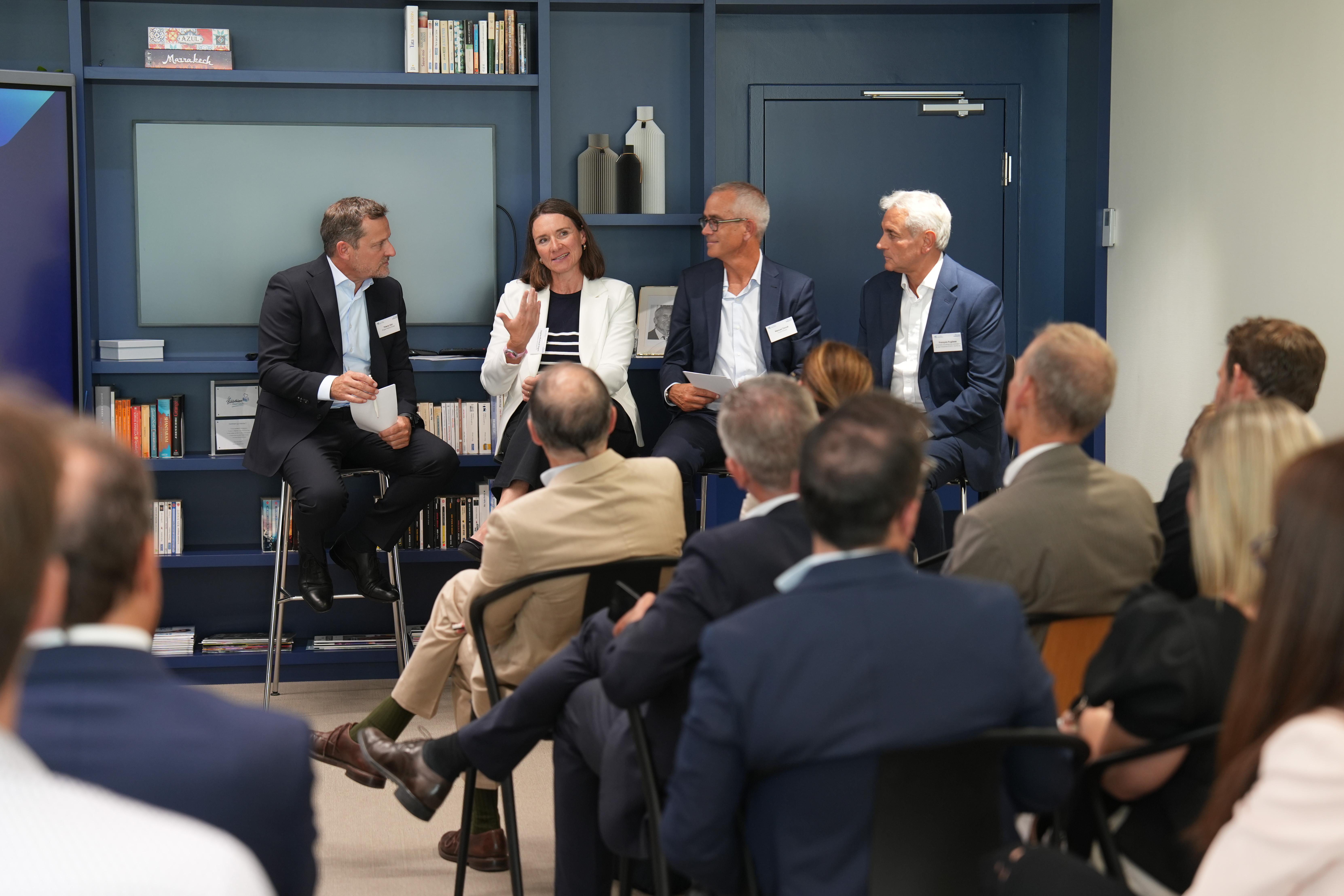
Just how much such a setting can achieve was demonstrated by the evening in Lausanne itself. In French-speaking Switzerland, as the host observed at the outset, distances are short but networks poorly connected. All the more valuable, then, that Forvis Mazars in Switzerland gave forty executives the opportunity to examine together a subject of considerable strategic weight that tends to get lost in day-to-day business.
Head of Communication, Lucerne Dialogue


You will find more information about our upcoming activities in our newsletter.

Register here for our newsletter!
